Valve Actuators
Actuation is the family of equipment that converts a signal or a power source into stem (or shaft) motion. The choice of actuator sets the available thrust or torque, the stroking speed, the fail action, and what happens when plant air or electric power disappears. Five power families are in common service — pneumatic, electric, gas-hydraulic, hydraulic and electro-hydraulic — and within pneumatics several mechanical layouts compete. Pick a family below for the full guide:
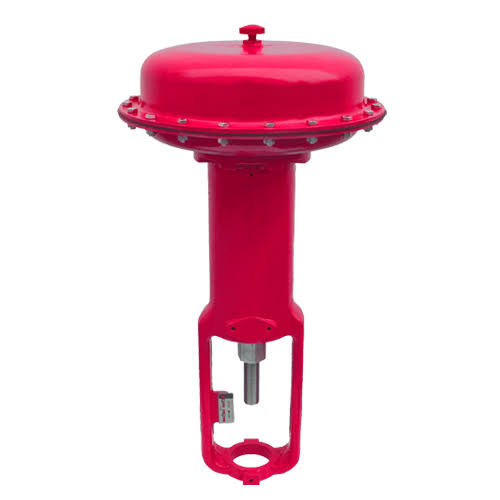 Diaphragm
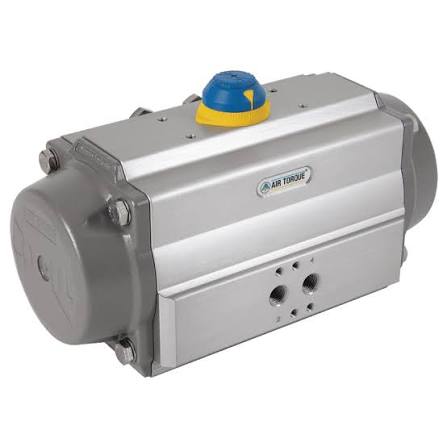 AT (Rack & Pinion)
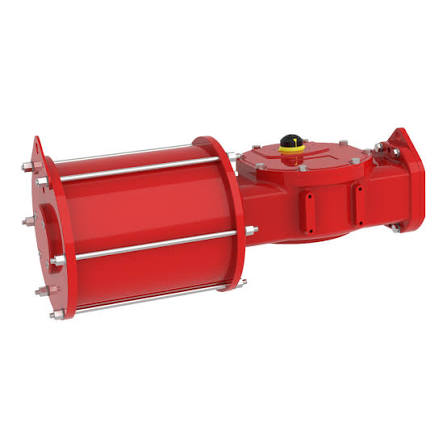 Scotch Yoke
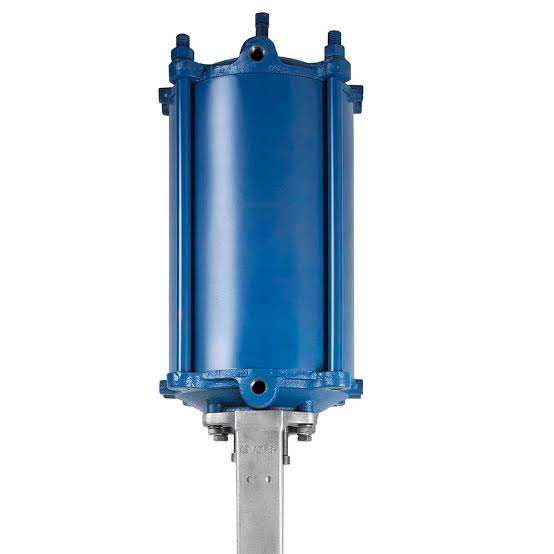 Piston Cylinder
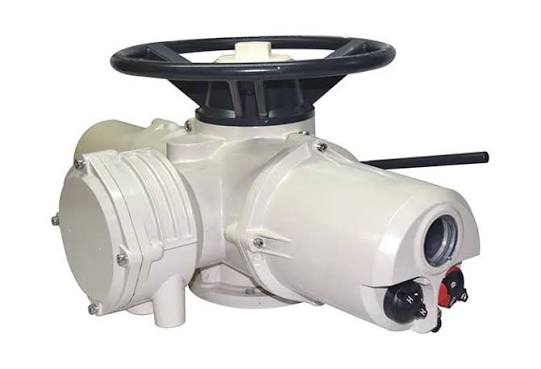 Electric
 Gas-Hydraulic
 Hydraulic
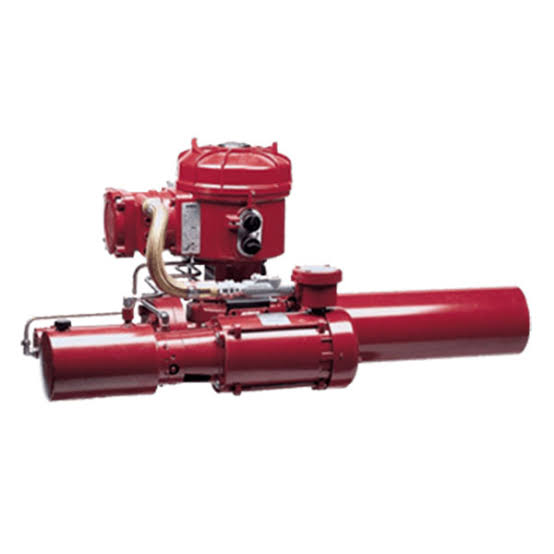 Electro-Hydraulic
Actuation Families — How the Valve Moves
Every actuator answers the same question with a different power source: how do I generate enough force, at the right speed, and fail in a defined direction when the supply is lost?
Diaphragm Pneumatic
Spring-opposed fabric-reinforced diaphragm on a globe yoke. The workhorse of modulating control: near-frictionless, naturally fail-safe by spring, but limited to roughly 3–4 bar and moderate thrust.
Full guide →Rack & Pinion Pneumatic (AT)
Two opposed pistons driving a pinion gear for 90° quarter-turn duty on ball and butterfly valves. Compact, symmetrical, available double-acting or spring-return; the standard "AT" series actuator.
Full guide →Scotch Yoke Pneumatic
Linear piston force converted to rotation by a yoke slot. Delivers its highest torque at the 0° and 90° ends — exactly where breakaway and seat-seating torque live — making it the classic large-trip-valve drive.
Full guide →Piston Cylinder Pneumatic
Full plant air on a sealed piston: higher pressure, longer stroke and faster stroking than a diaphragm. Linear for globe bodies, rack-converted for rotary.
Full guide →Electric
Motor-gearbox drives where instrument air is absent or uneconomic. Torque sizing, duty cycle, modulating vs on-off logic, and battery-backed fail action are the selection axes.
Full guide →Gas-Hydraulic
A gas charge (often pipeline or wellhead gas) acting on hydraulic fluid multiplies pressure into very high thrust without plant air — the standard ESD driver on large pipeline ball valves and wellhead chokes.
Full guide →Hydraulic
Oil-hydraulic supply at 100+ bar gives thrust and torque no pneumatic actuator can match, with smooth modulating response. Chosen for high-pressure letdown, subsea and heavy damper duties.
Full guide →Electro-Hydraulic
An electric pump pack feeding a hydraulic actuator as a self-contained unit: electric precision with hydraulic force. Used where mains power exists but air does not, and thrust demand is extreme.
Full guide →How the actuator fits the loop
A typical modulating loop reads: controller → positioner → actuator, with instrument air fed through a filter-regulator and boosted by a volume booster when the actuator is large. On trip valves, a solenoid intercepts the signal, and limit switches prove the final position. Where plant air is unreliable or absent, an electric actuator replaces the whole pneumatic chain.