Scotch Yoke Pneumatic Actuators
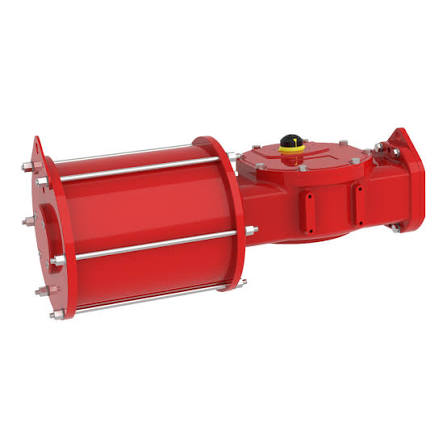
A scotch yoke actuator converts piston force into 90° rotation through a sliding yoke and pin-in-slot kinematics. The magic is the torque profile: output torque peaks at 0° and 90° and sags in the middle — nearly the mirror image of a quarter-turn valve’s torque demand, which peaks at breakaway and seating. That matching lets a scotch yoke do a given job in a smaller, lighter package than a flat-curve actuator.
How It Works
Two opposing pistons (or one piston in single-yoke designs) drive a common yoke plate. The yoke’s slotted arm engages a crank pin on the output shaft; piston motion slides the slot, rotating the shaft. Because the pin lever arm varies with angle, torque follows a sinusoidal profile — maximum at the travel ends.
- End-loaded torque — highest output exactly at breakaway and seating
- Double-acting (DA) — air on both strokes; highest output per frame size
- Spring-return (SR) — large spring packs; fail stroke on air loss for ESD
- Single vs double yoke — double yoke doubles pistons and thrust balance
- High-pressure pistons — up to 8-10 bar working pressure for compact frames
- End cushions — adjustable damping against seating shock
Types & Variants
- Cast-body medium duty — general process quarter-turn service
- Fabricated steel high duty — large ball valves, pipeline and subsea frames
- Spring-return multi-spring — ESD fail-safe on big torque demand
- Gas-hydraulic / hydraulic variants — same yoke on fluid power for extreme thrust
- Subsea and low-temp — compensated housings, special springs and seals
- Slotted-yoke vs pin-slider — kinematic variants by maker with different wear points
What to Compare Before You Buy
| Parameter | What it means | Why it matters |
|---|---|---|
| Valve torque curve | Breakaway, running, seating vs angle | The scotch yoke’s selling point is matching it — size against the real curve, not a single torque number |
| Minimum supply pressure | Torque tables collapse at low supply | Fail stroke (SR) must close the valve at the worst pressure the plant can deliver |
| Spring pack sizing | Fail torque at minimum supply | SR spring packs are the cost driver; verify against ESD requirement |
| Cycling rate & cushions | Strokes per hour, seating shock | Cushions and hardened yoke pins decide life under fast cycling |
| Frame construction | Cast vs fabricated steel | Pipeline and subsea duties demand fabricated frames and certified welds |
| Interface & certification | ISO 5211, NAMUR, API 6D / fire-safe packages | Pipeline and ESD service carries its own paperwork |
Where It Is Used
Large-diameter and high-pressure quarter-turn valves where breakaway torque is brutal and torque matching pays: pipeline trunk valves, big ball and plug valves, double-block-and-bleed trains, ESD service.
- Pipeline mainline ball valves (API 6D) with ESD spring return
- Large butterfly and ball valves in LNG and gas plants
- High-pressure class service where flat-curve actuators would double in size
- Subsea and buried valve stations with remote hydraulic/gas supplies
Common Brands
Field Problems & Fixes
| Symptom | Likely cause | Fix |
|---|---|---|
| Cracking / shock at end of stroke | Cushions unset or worn | Adjust end cushions; inspect bumpers on fast ESD strokes |
| Torque fell off, valve sticks mid-travel | Yoke pin or slot wear; dry sliding surfaces | Inspect kinematics; lubricate or replace pin/slot per manual |
| Fail stroke incomplete on ESD | Spring pack undersized for real minimum supply | Re-size springs against worst-case supply, not nominal |
| Piston seal blow-by | Aged seals, dirty gas over oil service | Seal kits; filter/gas quality check upstream |
| Casting cracked at cylinder mouth | Overpressure or freeze-up (water in supply) | Verify supply drying; inspect pressure rating |