Rack & Pinion (AT) Pneumatic Actuators
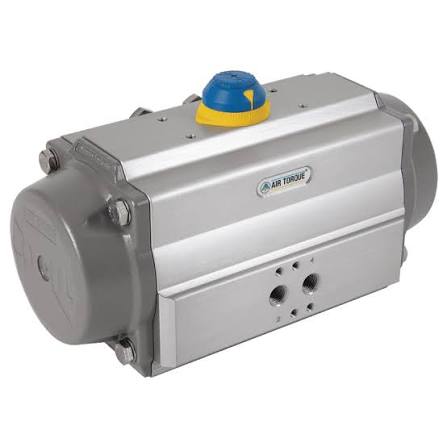
“AT” actuators — the industry shorthand for rack & pinion pneumatic quarter-turn actuators — convert linear piston motion into 90° rotation with two gear racks and a central pinion. They are the commodity workhorse under ball, butterfly and plug valves: extruded aluminium bodies, NAMUR and ISO 5211 interfaces, and a torque curve that is flat and predictable.
How It Works
Pressurising the left chamber drives its piston right; its rack pushes the pinion teeth; the opposing piston vents and follows. At 90° the porting flips (or the solenoid flips it). The pinion drives the valve shaft directly through a NAMUR star or ISO 5211 flange.
- Double-acting (DA) — air both ways; needs fail-action logic (solenoid, volume tank) elsewhere
- Spring-return (SR) — spring packs in the end caps drive fail stroke on air loss
- Flat torque curve — output torque roughly constant through travel (unlike scotch yoke)
- NAMUR star — direct mount to solenoid and switchbox interfaces
- ISO 5211 flange — standardised valve mounting with double-square drive
- Travel stops — external screws set 90° end points accurately
Types & Variants
- Extruded aluminium body — the commodity standard, anodised or coated
- Stainless / coated bodies — offshore, sour and washdown service
- Spring-return multi-pack — 3-12 disc springs per end cap, sized for fail torque
- Slot & wedge pinion variants — pinion engagement styles differ by maker
- Subsea / low-temp — special seals and springs for temperature windows
- Modulating duty — hardened gears and positioners for frequent strokes
What to Compare Before You Buy
| Parameter | What it means | Why it matters |
|---|---|---|
| Valve torque demand | Breakaway, running and end torque from the valve maker | Size DA actuators to breakaway with margin; SR to fail torque at minimum supply |
| Supply pressure | Typically 4-7 bar plant air | Published torque tables are per bar — quote the real minimum, not the average |
| Spring-return fail torque | Torque available on air loss at minimum supply | SR sizing is the harder case; fail torque collapses with supply pressure |
| Cycling duty & modulating service | Strokes per day, throttling motion | Hardened pinions and wear-rated seals for modulating duty |
| Interfaces | NAMUR star, ISO 5211, drive square | Wrong interface geometry shears keys and voids warranties |
| Environment | Temperature, corrosion, washdown | Anodising quality and seal material decide lifetime outdoors |
Where It Is Used
The default actuator for automated quarter-turn valves across water, chemical, LNG, mining and general industry: ball, butterfly, plug valves and dampers, on-off or modulating.
- On-off ball and butterfly valves with solenoids
- Modulating service with a positioner on the NAMUR interface
- ESD quarter-turn isolation with spring-return fail action
- Skid and OEM automation where ISO 5211 interfaces simplify builds
Common Brands
Field Problems & Fixes
| Symptom | Likely cause | Fix |
|---|---|---|
| Torque drops mid-stroke | Internal leakage across piston seals; wet, dirty air | Replace seal kits; dry the air supply |
| Hunting or creep in modulating service | Worn pinion teeth or loose travel stops | Inspect gear train; re-set stops; consider hardened modulating version |
| Fail stroke too slow | Spring return fighting undersized venting | Check solenoid Kv and dump path sizing |
| Corrosion seized actuator | Coating failure in coastal/offshore atmosphere | Stainless or re-coated body; verify fastener material too |
| Valve shaft key sheared | Drive square mismatch or over-torque on seat | Re-machine matching drive; re-check sizing against seat torque |