
Valve Positioners — the Complete Hub
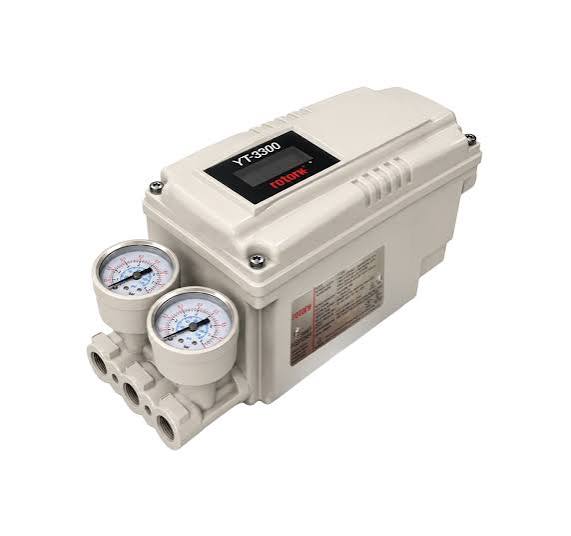
A valve positioner is a closed-loop device mounted on the actuator. It reads the controller’s command signal, measures the actual stem position through a mechanical or electronic feedback link, and modulates the air to the actuator until the two agree. Without a positioner, the actuator is an open-loop spring-pressure balance — sensitive to friction, packing drag and supply fluctuation.
What a positioner is for, and where you use one. Its job in one sentence: guarantee that stem position equals command, no matter what friction, pressure unbalance or supply fluctuation tries to do. You will find one on nearly every control valve in throttling service — pressure, flow, level and temperature loops on globe valves; large ball, butterfly and segment valves with heavy actuator forces; services with high packing friction or viscous, dirty media; and anywhere the loop needs split ranging, characterised curves or a defined fail action. On safety valves, smart positioners add friction diagnostics and partial-stroke testing that keep the loop provable between proof tests. If a valve only opens or closes and ±5% error is acceptable, skip the positioner — everywhere else it pays for itself.
Packing friction and seat drag create dead band — stem motion that lags the signal. In throttling service, dead band shows up as limit cycling that no amount of controller tuning removes. The positioner’s high-gain inner loop is the standard remedy, and it is also what makes split ranging, characterised action and air-fail definitions practical.
Working Principles — There Are Exactly Three
All positioners share one skeleton: compare command with feedback, amplify the error into air flow. What differs is how the command arrives and how the output stage is built. Pick a family:
1. Mechanical (pneumatic) positioner — force balance, nozzle–flapper
The command is a 0.2–1 bar pneumatic signal acting on a bellows or diaphragm. A flapper presses against a nozzle, and the resulting back-pressure drives a relay that ports supply air to the actuator. A feedback spring from the valve stem pulls the flapper back until the forces balance — stem position is then proportional to command. Fully air-powered: simple, intrinsically safe by nature, and still common in remote plants with no instrument electricity at the valve.
- Command signal: 0.2–1 bar pneumatic
- Feedback: mechanical cam, lever and spring
- Output stage: pneumatic relay (force balance)
- No electricity at the valve — inherently safe
- Continuous air bleed — needs clean, dry supply air
- Analogue zero/span screws for calibration
2. Electro-pneumatic positioner — I/P stage + pneumatic loop
The command is 4–20 mA. An internal I/P (current-to-pressure) converter turns the current into a proportional pressure, which then feeds the same nozzle–flapper force-balance stage. One device replaces the separate I/P converter plus pneumatic positioner that older installations needed. This is the workhorse type of modern plants — and the reason a failed I/P module is such a common positioner fault.
- Command signal: 4–20 mA analogue
- Feedback: still mechanical (cam + spring)
- Output stage: internal I/P + pneumatic relay
- Replaces separate I/P + positioner pairs
- I/P module = the most common field failure
- Analogue zero/span, HART rarely offered
3. Smart (digital) positioner — microprocessor + piezo or I/P output
The command is sampled digitally and compared with an electronic stem-position sensor (potentiometer, Hall-effect or capacitive). A microprocessor drives the output stage — piezo pilot valves on most Siemens/Azbil designs, an I/P stage on others — through a software control loop. What you gain: autostroke commissioning, digital protocols (HART, FOUNDATION Fieldbus, PROFIBUS), friction trends, signature capture and partial-stroke testing. What you manage: another electronic device in the field with its own configuration, alarm handling and power budget.
- Command: 4–20 mA + HART, or FF / PROFIBUS bus
- Feedback: non-contact — Hall / capacitive sensor
- Output stage: piezo pilot valves or I/P module
- Autostroke commissioning in minutes
- Near-zero steady-state air consumption (piezo)
- Diagnostics: friction trend, signature, PST
Output variants: single-acting vs double-acting
A single-acting positioner has one pneumatic output: it fills the actuator for one direction and relies on the actuator spring (or a fail-safe accumulator) for the return. A double-acting positioner has two outputs and ports air to either side of a piston — required for springless cylinder actuators and typical in high-thrust service. The output-side design must match the actuator type; this is the first thing to confirm before ordering.
Feedback variants: linear vs rotary, and characterisation
Linear (globe) valves take feedback from a lever on the yoke or stem; rotary (ball, butterfly, segment) valves take it from a lever clamped to the shaft. The feedback cam is also where characterisation happens: swapping the cam reshapes the command-to-position curve (equal percentage, linear, modified) without touching the controller. Wrong cam or wrong feedback ratio is a classic commissioning error — the valve “works” but the loop gain is quietly wrong.
Split ranging
With a positioner, one 4–20 mA command can be split at the valve end: valve A strokes over 4–12 mA, valve B over 12–20 mA, with no extra controller hardware. The positioner’s zero and span (or software range parameters) define each valve’s slice of the signal. This is how heating/cooling duplex control and sequenced vent valves are built.
Common Positioner Brands & Product Lines
The names below cover most of the installed base you will meet in the field. Brands with a full profile on RegValve link through.
Guides & Related Articles
Valve Positioners — the Full Guide
Selection, sizing, signal types and the engineering narrative behind every choice on this page.
Control Valve Troubleshooting
The field-symptom hub: hunting, slow stroking, position errors and what to check first.
Official Positioner Manuals (PDF)
SIPART PS2, FIELDVUE DVC6200, SVI II AP, 3730, ND9000, Logix, AVP, TZIDC — indexed from the manufacturers.