
Electro-Hydraulic Actuators
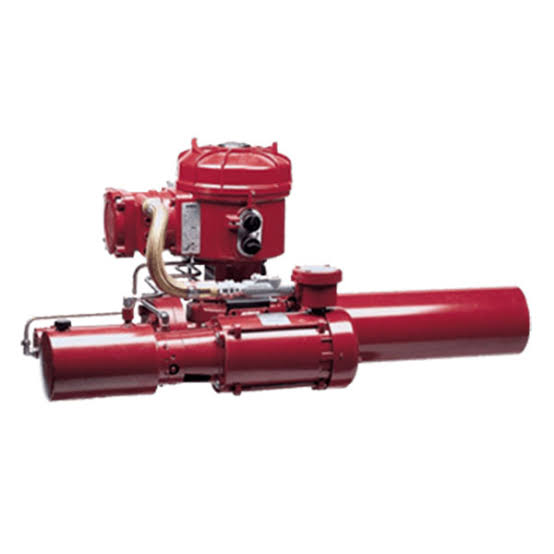
An electro-hydraulic actuator (EHD) builds the hydraulic power unit into the actuator itself: an electric pump charges a compact hydraulic circuit, and oil pressure drives the piston with the force density only oil provides. You get electric-actuator simplicity of supply (just power and a signal) with hydraulic-actuator thrust — and, in spring or accumulator builds, a genuine fail stroke on power loss.
How It Works
A motor-driven pump pressurises the internal circuit against an accumulator; directional valving ports oil to the actuating piston. On power loss, stored energy does the failing:
- Spring-return — mechanical springs drive the fail stroke (the certified choice)
- Accumulator reserve — pressurised nitrogen completes the stroke electrically-valved
- Pump sizing — sets stroking speed; large thrust + fast stroke = serious pump duty
- Directional control — solenoid or pilot valves route oil per command
- Modulating builds — servo/proportional valving tracks a positioner-style command
- Subsea variants — compensated housings and ROV hotstab interfaces
Types & Variants
- Linear EHD — gate/globe isolation and HIPPS thrust
- Quarter-turn EHD — yoke kinematics on an internal power pack
- HIPPS / SIS certified — fail-safe data for proof testing
- Modulating EHD — proportional valving for throttling duty
- Explosion-proof — Exd motors and housings for process zones
- Subsea EHD — depth-rated, pressure-compensated builds
What to Compare Before You Buy
| Parameter | What it means | Why it matters |
|---|---|---|
| Thrust / torque & stroke time | Seat load vs pump flow at minimum voltage | Pump flow, not just pressure, sets stroking speed — HIPPS strokes are contractual |
| Fail-safe mechanism | Spring vs accumulator reserve | Springs are mechanically certain; accumulators depend on valving and charge |
| Duty & thermal rating | Pump starts per hour, modulating capability | Frequent stroking heats the pump motor; verify the duty cycle |
| Power supply quality | Voltage sag, backup power availability | The pump is an electric machine — size against minimum voltage |
| Certification | SIL data, Exd, subsea depth rating | Match the safety study and area classification paperwork |
| Maintenance model | Oil condition, seals, onboard diagnostics | Self-contained units need scheduled oil and seal service like any HPU |
Where It Is Used
High-thrust duty where compressed air does not exist and electric thrust alone would be enormous:
- HIPPS and high-integrity ESD isolation (certified fail stroke)
- Offshore platforms without instrument air at the valve location
- Large choke and gate valves on remote pads
- Subsea and harsh-environment actuation packages
Common Brands
Biffi (Baker Hughes)
Biffi (Baker Hughes) — EH series electro-hydraulic actuators; HIPPS packages.
Rotork
Rotork — Fluid-power portfolio including self-contained EHD builds. Full profile →
Emerson (Bettis)
Emerson (Bettis) — Electro-hydraulic variants of the Bettis actuator line.
Flowserve
Flowserve — EHD actuation matched to severe-service valve lines.
Bernard Controls
Bernard Controls — Electro-hydraulic packages for high-thrust linear duty.
Severn Glocon
Severn Glocon — Engineered electro-hydraulic actuation for severe service. Full profile →
Field Problems & Fixes
| Symptom | Likely cause | Fix |
|---|---|---|
| Stroke time got slower | Pump wear, clogged suction strainer, low oil level | Service pump and strainer; verify oil level and cleanliness |
| Fail stroke did not complete | Accumulator lost charge or valve stuck; spring pack degraded | Proof-test the fail path; recharge/replace accumulator or springs |
| Motor thermal trips | Duty exceeded pump-motor rating | Re-rate the duty cycle; upsize the unit |
| Position hunting in modulating service | Proportional valve contamination or tuning | Filter the oil; retune the servo loop |
| Internal leakage / creep | Cylinder seal wear or directional valve bypass | Seal kits; test and service the valving |
Note. Generic engineering description for education. Brand names above are trademarks of their respective owners; RegValve.com is not affiliated with or endorsed by them. For installation and safety settings, follow the manufacturer’s manual and your plant procedures.