
Spring-Diaphragm Actuators
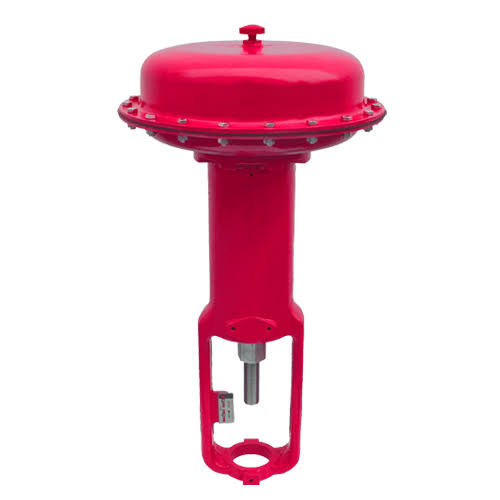
The spring-diaphragm actuator is the default actuator of process control: a fabric-reinforced rubber diaphragm loaded by air against a compression spring. Its virtues are exactly why it endures — inherent fail action from the spring, smooth proportional response, almost nothing to go wrong. Its limits are equally simple: thrust caps out at supply pressure times diaphragm area, and travel is short.
How It Works
Air pressure acts on the effective diaphragm area; the resulting force compresses the spring until force balance sets the stem position. Signal pressure maps linearly to travel across the bench-set range — the pressures at which the stem starts and ends travel.
- Direct-acting (air-to-close) — air pushes the stem down into the seat; fails closed on air loss
- Reverse-acting (air-to-open) — air pulls the stem up; fails open on air loss
- Bench set — e.g. 0.2–1.0 bar: travel starts at 0.2, ends at 1.0 bar, set on the bench before mounting
- Effective area — thrust = (signal pressure − spring start) × area; bigger case = more thrust at the same signal
- Multi-spring designs — several springs in parallel inside a compact case for higher force and a shorter profile
- Manual handwheel override — top-mounted gearbox for lockdown service
Types & Variants
- Single-spring, long yoke — the classic Fisher Easy-e geometry
- Multi-spring, compact — Samson/Neles style; shorter, stiffer, easier to insulate
- Double-acting diaphragm — no spring, air both sides; needs a positioner and fail-action logic elsewhere
- High-travel versions — for long-stroke cages and balanced plugs
- Low-temperature extension — grease-packed stem, extended bonnet integration
- Piston actuator upgrade path — when thrust demand exceeds diaphragm capability
What to Compare Before You Buy
| Parameter | What it means | Why it matters |
|---|---|---|
| Required thrust at shut-off | Seat-load demand from the valve datasheet vs dP | The actuator must seat against worst-case delta-P with margin — the first sizing line |
| Effective diaphragm area | Available force per bar of signal | Defines how much supply pressure (and which positioner) the job needs |
| Bench-set / spring range | Start and end pressure of travel | Must sit inside what your I/P + filter-regulator can actually deliver |
| Fail action | Closed, open or locked on air loss | Dictated by the HAZOP / fail-safe study, not by convenience |
| Travel | mm or degrees required | Diaphragm actuators are short-travel devices; long-stroke jobs need cylinders |
| Stroking dynamics | Response with and without a positioner | Dead band and lag are the positioner’s job; the diaphragm alone is an open loop |
Where It Is Used
The standard mover for throttling globe valves in refining, chemicals, power and water service — anywhere moderate thrust, short travel and inherent fail action cover the job.
- Globe control valves on pressure, flow, level and temperature loops
- Services where fail-closed or fail-open must be inherent, not commanded
- Moderate dP shut-off with balanced trim
- Loops with positioners, boosters and trip solenoids stacked on the yoke
Common Brands
Field Problems & Fixes
| Symptom | Likely cause | Fix |
|---|---|---|
| Valve will not stroke / rests on one stop | Diaphragm rupture — air blows straight through the case vent | Replace the diaphragm; find why (overpressure, heat, age) |
| Travel stops short of full stroke | Bench set wrong, or supply pressure too low for the spring range | Re-bench the actuator; check filter-regulator set-point and line losses |
| Creeping position with steady signal | Spring corrosion or packing drag — open-loop drift | Fit a positioner; inspect and repack the stem |
| Sluggish response on a large case | Long small-bore tubing, no booster | Upsize tubing; add a volume booster |
| Hysteresis between up and down strokes | Stem-thread or guide wear, worn diaphragm pad | Inspect guides and stem; replace the diaphragm if hardened |